
By Cindy Adams
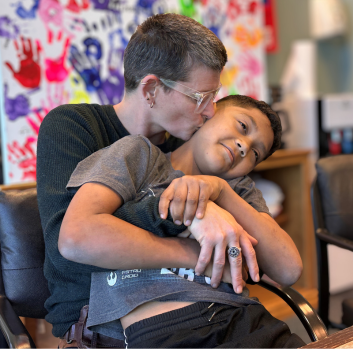
When Jessie and her son Verus go out on the paddleboard, he plants himself up front and tells her where to go. Left. Straight. Over there. He is nine years old and completely in charge, and Jessie is perfectly fine with that. She calls him Captain V.
Verus, who goes by "V," is also a student at enCircle's Roanoke Minnick School, but he will transition to public school this fall. He has come a very long way to get to this point, and, in his own words, he is "a little bit" excited about this next big step.
V's mom, Jessie, is now a teacher at Roanoke Minnick, partly due to being witness to V's success there. She also goes by Dr. Mann. Mann got her PhD at Virginia Tech Carilion. She was working in pediatric neurorehabilitation as a postdoctoral fellow at the National Pediatric Rehabilitation Research Center in Roanoke, when she signed up to be a therapeutic foster parent. That's how their paths crossed.
Jessie knew children with difficult histories would come through her door. She also decided early on she would take any sibling pair. The thought of brothers or sisters being separated deeply burdened her. So, maybe, it shouldn't have been a surprise when V and his brother, Roman, showed up at her home. She immediately felt like these were her kids. And she was right. Fostering led to adoption.
The boys had been through so much, especially V. In those early years, his world had been very small and very still. Because of his early years, V had missed out on normal childhood movement and because of Jessie's training, she knew exactly what that meant.
"Our brains develop within the context of movement," she explained. "It touches everything, including coordination, language, learning. For example, babies usually don't learn to point until after they learn to crawl."
As expected, V's development was severely delayed, so Jessie prioritized making movement a big part of their life. He now plays basketball through parks and rec and runs track through a free program called Speed Protégés. Jessie loads her car with neighborhood kids and brings them all. It's a new world for V and Roman.
Still, the years before Jessie and Minnick were hard. They tried many things. V was asked to leave most of the programs. Every time, he took it personally.
"He internalized the rejections," Jessie said, "he started telling himself he was a bad boy."
But Jessie refused to give up. Something a social worker told her at one time stuck: "If you walk into the woods for five years, it takes five years to walk back out."
V is still walking out of the woods, but not alone. His mom, brother, friends and teachers are alongside.
"The Minnick staff was different from the rest," Jessie said. "The educators here are trauma informed. They know the difference between defiance that needs to be addressed and trauma that needs space."
Jessie explained that V has been given extra chances. The teachers have stuck with him. And they constantly tell him they love him. V has never been made to feel like a bad kid. Not once. Instead, they did whatever it took to find a way for him.
"Minnick's approach is not rigid," Jessie said. "The staff have freedom to do what is right in the moment. Children who have experienced trauma have different responses. The staff at Minnick understood and they met him where he was."
Slowly, V stopped calling himself a bad boy. He started referencing his Minnick principal and teachers repeating, "Bays loves me. Ms. Brittany loves me."
Here is what Jessie wants you to know about V. From the very beginning, even in the worst days, he was one of the most loving children she had ever met.
"There was so much love in him just waiting to get out," she said.
He is perfectly polite. He has a ton of character. He is good at math and not a fan of English. He loves playing. He knows exactly what goes on a hotdog (mustard, mayo and pickles). He has an amazing smile. He is Captain V.